Modernist Cuisine

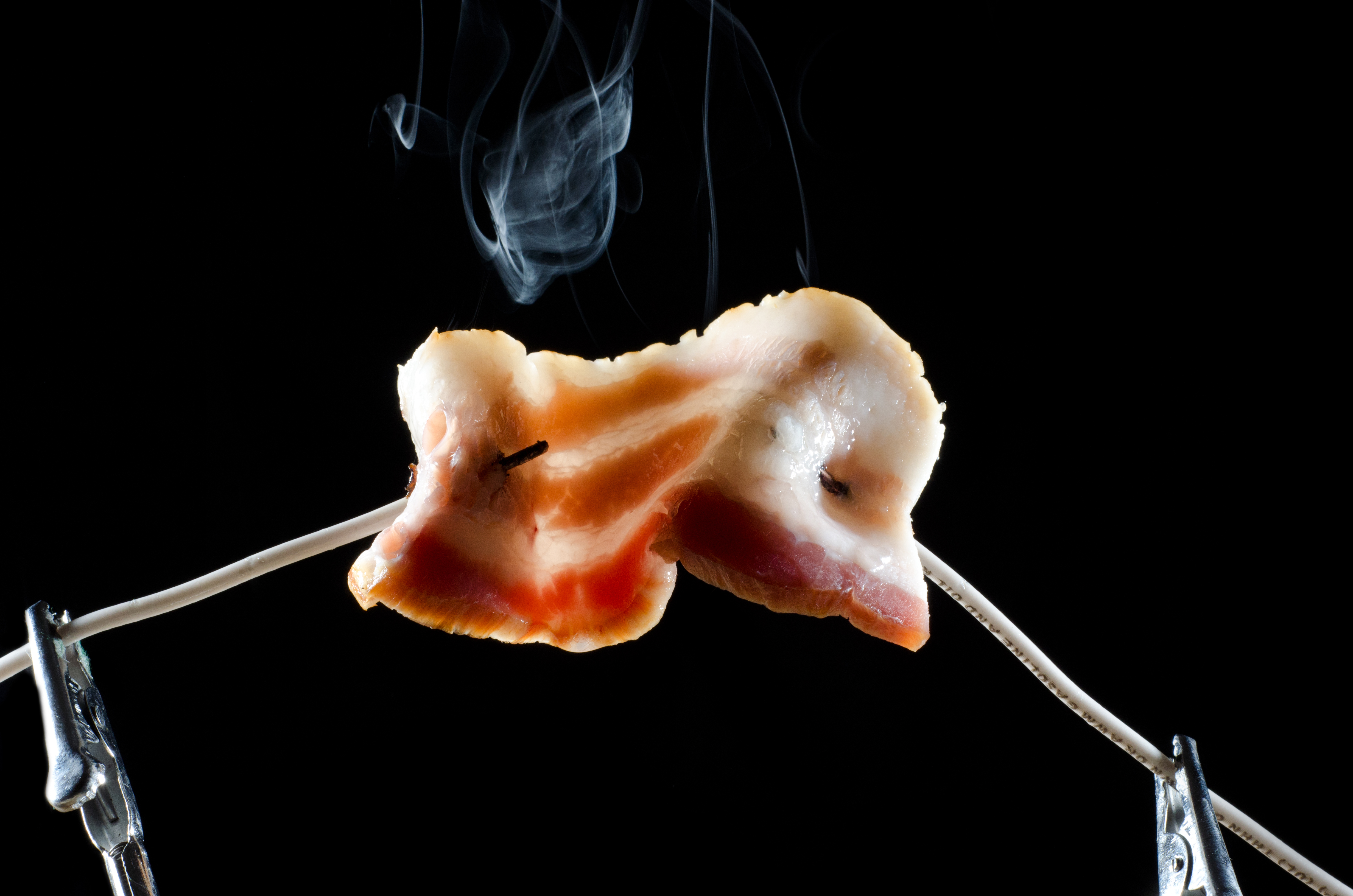
This week I had the extreme privilege to get a lesson in food photography from Ryan Matthew Smith, the principal photographer for Modernist Cuisine. We recreated a few shots from the book and Ryan explained some of the techniques he used to create those jaw-dropping photos. In this article, I’ll give you some of Ryan’s best tips and tricks for shooting food in this style. We’ll cover the lighting setup for each shot, talk about the equipment that Ryan uses, and even look at some at-home alternatives. Finally, as a reward for reading all the way through, you can watch gelatin bounce in extreme slow motion
In Part 2 (coming soon), we’ll walk through a set of steps in Photoshop to pull out the hyper-real detail and lighting that make Modernist Cuisine’s food seem to jump off the page.
It takes five minutes to unpack the Modernist Cuisine books. Five. I know… I counted.
Several weeks ago, when I brought home a review copy of Modernist Cuisine, I was too eager to bother documenting the unboxing process. However, now that I’ve purchased my personal copy (for-keeps) I thought it would be worthwhile to share the experience of opening it up for the first time.
The video above shows the process from start to finish. First there’s the outer box (note the shipping weight on the label). Then, you reveal the inner box, suspended in air by six rigid cardboard pyramids. Inside the inner box, there are thick cardboard panels which completely surround a mysterious white package (hint: it’s the books!). On the other end, the kitchen manual hides in a box of its own.
Although it may seem like the Matryoshka-style packaging was added to create a tantric unboxing experience, it actually serves a purpose: protecting the acrylic book case from breaking during transit. One of the reasons that the original shipping date was delayed, in fact, was that the previous version of the packaging had failed a “drop test”. When you’ve got 50 lbs. of books sloshing around in a box, cushioning counts.
If you’re still waiting on your copy to arrive, I hope this video gives you a moment of vicarious pleasure. And, in case you’re wondering, yes I saved the box.

Nathan Myhrvold’s presentation on the Modernist Cuisine book is loaded with astonishing facts and figures: over 2400 pages, 46 lbs., 4 pounds of ink… the list goes on. But, he leaves out a great deal of the behind-the-scenes facts about the book and the process of its creation. As we enter early April, just under a month after the first copies shipped, we are finally uncovering details of the real story behind Modernist Cuisine. Below are a a few little-known facts that I was able to gather from members of the kitchen team who have asked to remain nameless.
- The working title of the book was How to Boil Distilled Water At Sea Level Using A Conductive Heat Source and a Wet Bulb Thermometer. It was later changed to Modernist Cuisine to conserve ink.
- A month before the book went to print, the team decided to cut a 6th volume that described the physiology of the human body’s digestive process.
- As lifelong fan of hidden clues and puzzle-solving, Nathan has placed a secret clue inside the printed pages of book 5. If you cut off the book in half vertically down the exact center and view each half from the side, the interior edge of the stacked pages reveals the recipe for Three-Course Dinner Chewing Gum.
- The book originally included a recipe for Coca Cola, which the Modernist Cuisine team reverse-engineered using a mass spectrograph. However, efforts to recreate an edible aluminum can were problematic, and the recipe was ultimately discarded.
- The iconic “cutaway” photos in the book were actually created using a prototype device that resembles a light saber. Intellectual Ventures has several working “light sabers” which it uses for testing defenses against (according to a research assistant) “pests significantly larger than a mosquito”.
- During the book’s production, photographer Ryan Matthew Smith was asked to leave a Seattle restaurant after connecting a fiber optic strobe flash to his cell phone camera and tossing his meal in the air. Ultimately, the restaurant owner apologized and asked to purchase the photo.
- One of the more famous recipes in the book is the Modernist Hamburger, which requires over 30 total hours and a bowl of liquid nitrogen to create. Unfortunately, the team decided to exclude their recipe for “2 AM Mini Hamburgers”, which was inspired during the teams extensive experiments with methods of smoking herbs.
- The recipes in the book have clearly undergone rigorous testing. However, the extent of the tests is often greater than we realize. For example, one member of the culinary team spent four days measuring the number of licks it takes to get to the tootsie roll center of a Tootsie Pop. He concluded, applying the central limit theorem, that the number is three.
- Although it is true that the genesis of the book was Nathan’s desire to understand sous vide cooking, it is not widely known that Nathan turned to sous vide because his microwave had broken and he needed a reliable way to reheat frozen taquitos.
- If you were to sum the cooking time for all of the recipes (not including parametric variations) included in the books, the result would be 8 years, 2 months, 15 days and 9 hours. However, the book was completed in fewer than seven years, leading some to conclude that Nathan Myhrvold has secretly developed a time machine.
I hope these facts have given you an inside look at the creation of Modernist Cuisine. And, as always, happy April fool’s day.

For the past year, I’ve been meeting with Jethro Odom and Eric Rivera several times a month to challenge ourselves to learn modernist cooking. We call ourselves Jet City Gastrophysics, a name that we use with a healthy dose of levity. Part of our mission has been to learn a new set of fundamentals – working with hydrocolloids and emulsifiers, cooking sous vide, using a centrifuge, spherification, using liquid nitrogen and dry ice, experimenting with transglutaminase (meat glue), making powders and mastering dehydration, pressure cooking, and a whole lot of deep frying. These techniques are being employed by a small but growing handful of chefs worldwide, but by very few restaurants locally.
For the past 5 months, our goal has been to craft a menu that lets us showcase what we’ve learned, and present a dining experience that is unique and distinct from anything you’ll find elsewhere. We’ve named this project our “Thesis Dinner”. Earlier this year, we got the official word that we would have the opportunity to host some very special guests in April (but more on that later). With an applewood fire lit under our asses, we presented the first run through of our menu this week to a small group of guinea pigs, none of whom experienced any form of foodborne illness (or vertigo). Below is a small glimpse at a few of the dishes we’ve been working on, with much more to come in the next few months.
Above: Shrimp Cocktail. Restructured shrimp on a sesame tuille with clementine, chili oil and grapefruit zest. Underneath is cocktail sauce for sous vide shrimp.
Fried Egg. Sous vide egg yolk on a cilantro stem nest. Hollandaise, Sriracha salt.

Duck prosciutto (care of Eric Rivera). Olive oil and edible flowers.

Take out Pho with Playful Accompaniments (not shown).

Sweet Sushi: lima bean gel, coconut rice, nori.


As a heuristic, I tend to avoid foods labeled as “vegan” because, in my limited experience, they tend to be poor imitations of their non-vegan counterparts. Sure, a tomato is both vegan and delicious, but I’ve never met a vegan pizza that tasted better than the paper on which they print Dave Matthews tickets. However, at my first visit to the Intellectual Ventures kitchen lab last summer, I ate a bowl of pistachio gelato, which I was later informed was (you guessed it) vegan! The gelato was smooth and silky, and unquestionably better than any lactose-free ice cream I’ve ever tried. And although the Modernist Cuisine book doesn’t wander into the realm of desserts, luckily for us, their pistachio recipe is their sole exception. I’ve substituted cashews for pistachios, but other nuts will work just as well. I’ve also simplified the emulsifiers called for in the book, which means you can find everything you need to make this recipe at a (finer) grocery store.
Shopping list:
- 680 g water
- 210 g cashew butter (available in the nut butters aisle at Whole Foods)
- 102 g cashew oil
Note: I haven’t been able to find a bottle of cashew oil, straight up. Instead, I poured off the oil that had settled at the top of my cashew butter. Using this amount only yielded 1/5 of the recipe. You can sacrifice 4 more jars, or substitute the remainder with walnut, hazelnut, macadamia, peanut, or even safflower oil – just make sure the oil is unused, or your gelato will taste like french fries. - 155 g fine baker’s sugar
- 22 g salt
- 2.5 g Xanthan gum
- 2.5 g Guar gum
Note: both Xanthan gum and Guar gum are available under the Bob’s Red Mill brand at finer grocery stores.
- Combine the water, cashew butter, cashew oil, sugar and salt in a food processor or blender. Blend until very smooth.
- Add the Xanthan gum and Guar gum and blend until combined, about 30 seconds. The mixture should thicken to the consistency of cream.
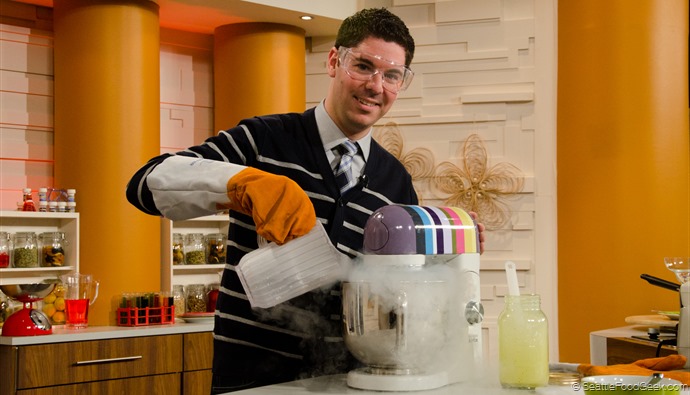
- If necessary, chill the mixture in the refrigerator for 1 hour. Churn in an ice cream maker, following the manufacturer’s instructions. If you don’t have an ice cream maker, break 2.5 lbs of dry ice into 1/2” pieces. Add the gelato base to a stand mixer with the paddle attachment installed. Mix on medium, then add the dry ice. Continue mixing until the dry ice fog has stopped. Transfer to an airtight container and store in the freezer.
This gelato screams “cashews” and is delightfully salty. Now that you’ve got a reliable recipe for nut-based vegan gelatos, you can finally open that Fremont dessert shop you’ve always dreamed of… bongo drums and all.
Tuesday night was the official book launch party for Modernist Cuisine, the 2400+ page epic that can only be defined loosely by the term “cookbook”. Although it doesn’t begin shipping until March 7th (and you may have to wait longer than that), the book has already sold over 3400 copies in pre-order and has entered Amazon.com’s Top 100 for books, not just cookbooks.
The launch party, hosted at the Palace Ballroom, was a sold out but still intimate evening. Admission included a small plate of samples from the book – dehydrated pear, a cube of pastrami with a rye cracker, fried chicken, and a dehydrated corn chowder that blasts into existence only once inside your mouth.

Tom Douglas introduced Nathan Myhrvold, the book’s creator, with obvious reverence and respect. Apparently, on Monday night, and a handful of renowned chefs, including Tom, gathered at the Intellectual Ventures kitchen lab in Bellevue and were treated to a 30-something course dinner of a lifetime. One of the ironies in the way this book was made was that there is no restaurant associated with their kitchen – they have no customers, so until recently, nobody knew what the food tasted like, exactly. Luckily for a handful of world-class chefs and prominent journalists (and on a separate occasion, one extremely fortunate food blogger, me), the Modernist Cuisine team has been throwing a series of dinner events to prove just how good these dishes taste.
Nathan spoke to the crowd, armed with a PowerPoint to show off spreads from the book, and talked with his usual candor about the process of creating the book. He commented on the risk-averse nature of both the US Department of Health and the world of book publishing – the former being a politically-driven machine full of inconsistency, and the latter being a least-common-denominator-driven machine full of compromise and devoid of flexibility. He seems to have set both of those industries straight, likely to their embarrassment.
The audience oohed and aahed when Nathan showed footage captured by his super-high speed camera – a corn kernel popping, oil drips hitting a a hot coal, droplets of liquid nitrogen dancing on the surface of a counter. At one point, he showed an extremely slow motion shot of a champagne cork popping from the neck of a bottle. It was the stuff rap videos are made of, minus the spinning rims.
During the Q&A, Nathan made the themes of the book very clear: they refused to compromise on quality, nothing should be “dumbed down”, and the vast majority of the book really was accessible to anyone with some basic kitchen gear. However, it was near his closing remarks that Nathan really explained his motivation. “I wanted to write this book as a way to give back to the world of cuisine, which has given me so much.” Indeed, I hope the world of food can continue to find benefactors as generous and as genius as Dr. Myhrvold.
Modernist Cuisine [Amazon]

If you haven’t already, read How The Modernist Cuisine Book Caused My Existential Crisis – Part 1.
And so I wallowed in my untimeliness, still gawking with the turn of every page at the unparalleled photography and exhaustive parametric permutations of each new recipe. “What could I possibly write now?” I questioned. And then I had a realization….
It occurred to me that the modernist food revolution I was so sad to miss has actually just barely started. Rather than feeling “late to the party”, I now recognize that the publication of Modernist Cuisine represents a critical phase for the movement: democratization.
Until now, only a few chefs in the world have been able to execute the types of dishes featured in the Modernist Cuisine book. Most of these chefs (Ferran Adira, in particular) are highly skilled and highly creative people, but they’re also people who have the time and resources to devote to such an R&D-heavy brand of cooking. Experimentation certainly doesn’t come cheap.
Let’s take, for example, the problem of thickening…
Right now, I’m one of the few very fortunate people in the world who have a copy of the Modernist Cuisine book. I’ve been a vocal fan(boy) of the project for nearly a year now. As my wife can attest, discussing the subject of this book has been a favorite pastime of mine… at cocktail parties, friends’ birthdays, on vacation, to tech support call operators, at drive-through windows, and to just about anyone else who will listen. About two weeks ago while I was driving to work, I got an email asking if I could swing by the Intellectual Ventures office to pick up a review copy. I nearly drove my car through the median in my eagerness.
I got the books, brought them home, and posted an “unboxing coming soon” teaser article. That was two weeks ago. Since then – not a single mention. The books that I’ve been salivating over for nearly a year finally arrive and I don’t post a word. What happened?
I had an existential crisis.
Ferran Adrià is the most influential chef, living or dead, period. He’s also likely the most controversial. At his Catalonia restaurant El Bulli, Ferran has spent the last few decades turning the culinary world on it’s head, breaking rules, toying with emotions, and inventing never-before-conceived ways of imagining food.
Unfortunately, you may know Ferran best by his most extreme techniques, which are often implemented poorly by far lesser chefs (yep, I’ve been guilty of that). His most recognizable methods include making foams and turning liquids into encapsulated spheres, both of which quickly denigrate from masterful haute techniques into party gags rather quickly. However, in the hands of (by all accounts) a master/genius/sorcerer/+5000 Mana Food Priest, these methods contribute to a transformative and even transcendent dining experience.
Through Colman Andrews’ unprecedented access to Ferran, we learn about his fascinating and serendipitous career progression from military dishwasher to short-order beach bum, eventually becoming the most renowned chef in the world. We also learn much of the history of El Bulli and how the location, landscape and struggling seasonality of the restaurant ultimately contributed to its unlikely success.
What we don’t learn, though, is much about Ferran, personally. Although he dispenses a bevy of prolific statements throughout the chapters, nearly nothing is written about his life outside the kitchen, his wife or his relationships with friends. In fact, reading about his many simultaneous projects and ventures, I began to wonder if there was any off-duty time to discuss at all!
Skeptics of “molecular gastronomy”, a term which Ferran and others abhor, may find this book less than satisfying – the brief chapter on the opposition to Ferran’s food only lightly grazes the surface of the common knee-jerk responses to modernist cooking, and regrettably does very little to dispel the pervasive untruths that are frequently held against Ferran and his disciples. However, for a geek like me wishing to emulate the patterns and unbounded thinking that made Ferran Adria such a powerful force in the modernist food movement, this book was a fantastic glimpse into the mind of a genius.
Amazon: Ferran: The Inside Story of El Bulli and the Man Who Reinvented Food

It is undeniably fashionable, these days, for an upscale restaurant to serve “their take” on macaroni and cheese. I’ve seen it prepared at least a dozen ways: with wild mushrooms, with truffles, with bleu cheese, with cave-aged gruyere, in mini-cocottes, on oversized platters, broiled, baked, and deep fried. For the record, there’s nothing wrong with any of these preparations. In fact, we served a wild mushroom and truffle oil mac & cheese at my wedding! However, I wanted to take the concept to the extreme and produce the most hyperbolic, modernist version of the dish I could… just to see what happened. The result: maltodextrin-powdered Beecher’s cheese with a tableside hot cream to make an “instant” sauce.
I originally thought I’d post my results as a joke – an over-the-top preparation that was to comfort food what the Dyson Air Multiplier is to climate control. However, I was delightfully surprised to find out that this mac & cheese actually tasted fantastic! The flavors are extremely pure and the consistency of the instant sauce was perfect. Watch out, Kraft… you’ve got competition.
Makes: 2 snobby servings
Total kitchen time: 4 hours (45 minutes working time)
For the Powdered Cheese:
- 100g Beecher’s Flagship (or Smoked Flagship, if you prefer), grated
- 30g water
- .4g sodium citrate
- 200g (+15g) tapioca maltodextrin
- Preheat your oven to its lowest setting (180-220°F).
- Combine the cheese, water and sodium citrate in a small saucepan. Heat on low until completely melted. Stir to ensure evenness.
- Transfer the cheese mixture to a small food processor and add 200g of tapioca maltodextrin and process until it forms a paste. If you can’t fit all of the tapioca maltodextrin at once, add half and process, then add the remainder.
- Spread the paste in a thin, even layer onto a silicone baking sheet. Bake until dry and brittle, 2-3 hours.
- Crumble the cheese mixture into a food processor, or preferably a clean, electric coffee grinder. Process until the mixture becomes a fine powder. If necessary, add an additional 15g of tapioca maltodextrin. The mixture should have the same texture as the powdered cheese in instant macaroni and cheese.
For the dish:
- 1 cup pipe rigate (or any other type of macaroni you’d like)
- 1/4 cup heavy cream
- Hawaiian black lava salt
- 2 sprigs thyme
- Cook the pasta according to the instructions on the box.
- Meanwhile, heat the heavy cream to a simmer. Just before serving, divide the cream into two mini sauce pots (I used glass port sippers, shown in the photo).
- To plate, sprinkle a two tablespoons of the cheese powder into a small bowl. Top with pasta, sprinkle with a pinch of black lava salt, and garnish with thyme. To finish the dish tableside, pour over the hot cream and stir well to make the cheese sauce.
I owe a big thanks to Maxime Bilet (author of Modernist Cuisine) for giving me a hand with the powdered cheese recipe. If you aren’t up for ordering a pound of maltodextrin online, you can also use my simplified powdered cheese recipe from the Beecher’s Cheddar Cheetos article I wrote for Seattle Weekly. However, tapioca maltodextrin (N-Zorbit) is pretty handy stuff for turning liquids into powders, and is a staple in modernist kitchens.

If you’ve been playing along at home, you know that I’m a teeny-tiny bit obsessed with the soon-to-be-released, 2400-page Modernist Cuisine book. Well, my excitement skyrocketed last week when I had the rare privilege to peek at a few hundred [digital] pages of the book, guided by author, CEO and hero of geeks everywhere, Dr. Nathan Myhrvold. I was honored by the invitation, which I can only assume was prompted by a prank phone call from the Make A Wish Foundation on my behalf.
Among the seemingly endless pages of stunning photographs, captivating history and practical instruction, the book is sprinkled with fascinating tidbits like this one. Did you know that you can measure the speed of light using your microwave and a few slices of Kraft Singles?
From the section “Cooking in Modern Ovens”:
You can measure the speed of light by melting cheese, chocolate or even marshmallows in your microwave. Microwave cooking leaves patterns of melting on soft, smooth surfaces that correspond to roughly half the wavelength of a microwave. These patterns are caused by the way the microwaves crisscross in the oven chamber and either combine their energies or cancel one another out.
Here’s how to replicate the experiment at home.
- Cover a flat plate, platter or cardboard disc with soft cheese slices.
- Place the plate in the microwave. If your microwave has a turntable, disable it, or remove the turntable platter and place the plate on an inverted ramekin to bypass the turntable motor.
- Heat on low power until it has melted in several spots.
- Measure the distance, in millimeters, between the centers of any two melt spots. Double that number to get the wavelength.
- Multiply the wavelength by the frequency, in MHz, of your microwave (listed on the back). For example, if your microwave is 2.45GHz (typical), you’d multiply by 2,450,000. [We multiply by MHz instead of GHz to fudge in a factor of 1000, which is the conversion from millimeters to meters.]
- Compare your value to the generally accepted value of 299,792,458 meters per second
The value I calculated was 306,019,200, which is is only off from the actual value by 2%. Not bad for fake cheese!
Between now and the release of the book in March, I’ll be highlighting a few more geeky food tricks from the book. In the meantime, you can find more information at http://modernistcuisine.com/. If you’re ready to pull the trigger, the book is available for pre-order on Amazon.com.

Here she is, ladies and gentlemen, in all her 46lb glory! This is the first published image of the Modernist Cuisine books, in their acrylic case. This shot doesn’t show the accompanying kitchen manual, but it is enough to make food geeks everywhere salivate. That March 14th date can’t come soon enough!
I had this grand idea for a “gingerbread” house this year: a scale replica of the Seattle Central Library building – one of the few modern architectural landmarks of our city, and a magnificently example of complicated geometry. I planned on making the whole thing out of sugar, since the library building has an all-glass exterior. And, to top things off, I was going to laser-cut all of the pieces I needed, since the project clearly wasn’t geeky enough to begin with.
Instead, I ended up with this 6” spiral staircase. Let’s review what happened…
‘Tis the season of giving, and particularly, giving back. Unfortunately, hunger remains a pressing issue in Western Washington. Every day, far too many individuals and families don’t know where they’ll find their next meal. Luckily, Seattle is home to more than a few fantastic role models for the fight against hunger. One such leader is Chef Maxime Bilet, a member of the Intellectual Ventures team and co-author of the Modernist Cuisine book (available in March 2011). I had the chance to ask Maxime about his work with the Hunger Intervention Program and how modernist cooking fits in with fulfilling basic nutritional needs.
What does the Hunger Intervention Program do, and why is it important to Seattle?
The Hunger Intervention Program (HIP)is a local non-profit here in Seattle whose mission is to provide nutritious meals and basic cooking skills to the homeless and hungry. HIP’s new initiative is the Community Kitchen – an incredible initiative to help empower homeless and low income families to feed themselves by providing hands-on training in food preparation, safety, and nutrition education. They have recently begun using the community kitchen to reach out to mentally disabled patients.


Read SeattleFoodGeek.com on your Amazon Kindle!